
RenoMate field notes
HDB Toilet Renovation: Check HIP Before Paying Twice
You are planning a resale-flat renovation and the bathrooms look tired. A contractor quotes for new tiles, fittings and a vanity, while someone mentions that the block may get HIP. Should you renovate now, wait, or do only part of the work? The answer depends on more than the age of the flat.
The useful starting point is to separate three things: work needed to keep the bathroom safe and usable, work covered by an actual upgrading programme, and changes you want for appearance or convenience. When they are bundled together too early, you can end up paying for a finish that another team later needs to remove.
Before accepting a bathroom package
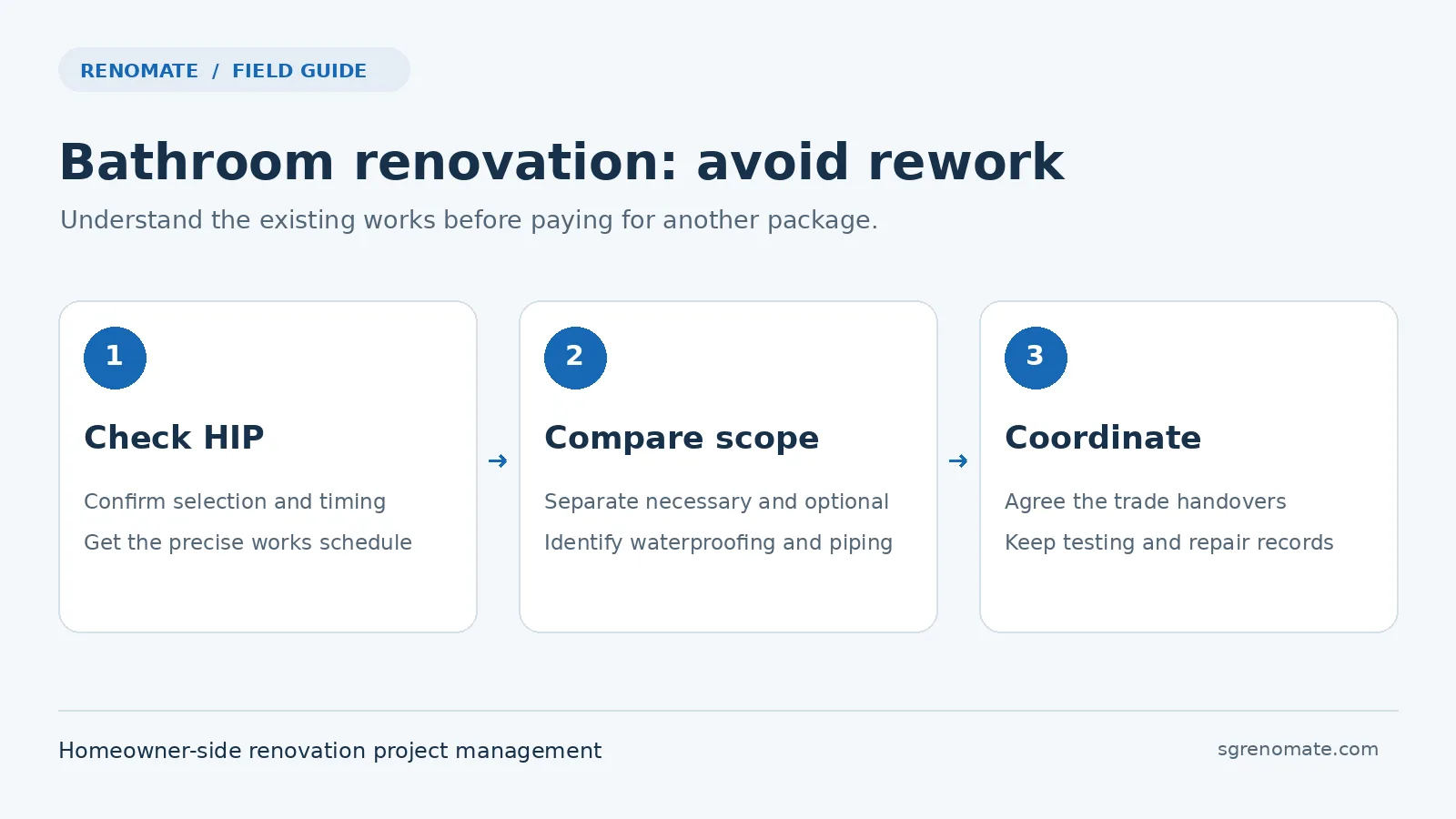
Confirm the block's programme status, obtain the precise work scope and identify any overlap with your private renovation. Treat an unconfirmed future upgrading date differently from a scheduled visit to your flat.
What HIP changes about the renovation decision
HDB's Home Improvement Programme, or HIP, distinguishes essential improvements from optional items, including toilet upgrading. Selection and the programme process matter; the age of your flat alone does not establish when work will reach your unit. Check the current position with HDB or the HIP information centre before making commitments.
Ask what is included, what choices you have and which surrounding areas need access. A general statement that “HIP will do the toilets” does not tell your private contractor what to exclude from a quotation or when to return for the remaining work.
| Your situation | First check | Practical approach |
|---|---|---|
| HIP works are scheduled | The unit-level scope, access needs and sequence. | Coordinate overlapping work before buying finishes or booking private trades. |
| The block is selected but timing is uncertain | The actual programme stage and expected next update. | Compare a limited interim repair with a full renovation; avoid assuming a firm start date. |
| No confirmed programme | The current bathroom condition and your likely period of use. | Make the decision on present needs rather than an unsupported promise of imminent HIP. |
| An active leak or safety concern | The cause and necessary immediate action. | Seek assessment promptly. Do not wait indefinitely for a possible upgrade. |
Pipe access can affect cabinetry outside the bathroom
This is not only a theoretical coordination problem. HDB's published guidance for the Tampines Street 45 HIP precinct with works planned in 2026 explains that existing cabinets may need removal if they obstruct soil or waste-pipe replacement, with reinstatement outside the HIP scope borne by the owner. Its instructions also call for privately arranged work and costs to be agreed in writing through the relevant process.
That precinct's dates and details are not a timetable for every HDB block. The broader planning lesson is to confirm access before installing new joinery around services. A cabinet can be perfectly built and still be badly timed if another team must reach the pipe behind it.
Before finalising cabinetry, mark the services that need to remain accessible and ask the HIP team about the planned work. Let the carpenter respond to the confirmed requirements. Do not assume a decorative access panel will be sufficient without checking the actual repair or replacement method.
Separate a leak repair from a cosmetic upgrade
A ceiling stain, damp wall or recurring wet patch needs an assessment of its source. HDB's ceiling-leak guidance explains why investigation and the appropriate repair matter. Do not assume every stain has the same cause or that installing a new surface will resolve the underlying issue.
Ask the assessing contractor to explain the observed problem, proposed repair and what evidence will show whether it worked. Keep photos and the inspection record. Where neighbouring units or common services may be involved, clarify who needs to inspect and coordinate access rather than assigning responsibility from a photograph.
A tile overlay is a design or installation proposal, not proof of a waterproofing repair. Before choosing it, ask whether the underlying condition has been assessed and what the proposal does to the doorway, floor level, drainage and fittings. A lower-disruption option is only useful if it is suitable for the actual bathroom.
Know which checks happen before concealment and which happen after
For replacement toilet floor finishes, HDB's renovation conditions require the appropriate waterproofing works and a water test after the new floor finishes are laid. Ask the contractor to identify the applicable requirements and record the test. An earlier inspection of concealed work does not replace that final required test.
Our practical suggestion is to agree checkpoints before the work starts: a condition review, a check of the relevant preparation before it is covered, and the required testing and final inspection. Ask who will carry out each check and who receives the record. Photographs are useful evidence, but they do not certify performance by themselves.
Plumbing responsibilities also need to be clear. PUB's plumbing-work guidance requires licensed plumbers for regulated water-service and sanitary-plumbing work, while distinguishing some simple exceptions. Ask whether your scope includes regulated work and who is responsible for it, rather than assuming every bathroom task can be handled by the same installer.
Write down where HIP ends and the private renovation begins
Create a scope sheet with a line for each major item: floor and wall finishes, waterproofing, pipes, sanitary fittings, electrical work, doors, screens and cabinetry. For each, identify the responsible party, whether it is included in HIP or separately arranged, and what must happen before the next installer attends.
This is especially important for owner-supplied products. Agree who checks compatibility, who accepts delivery and who installs them. A shower screen installer should not discover on arrival that the preceding works are incomplete or that nobody has confirmed the permitted fixing arrangement.
Keep invoices and defect-reporting contacts for privately arranged work separate from the HIP records. When an issue appears later, you need to identify the relevant scope and party without reconstructing the whole project from messages. Our renovation quotation guide can help you make those inclusions and exclusions explicit.
Plan for the household, not only the contractors
Ask when water, toilets and access routes will be affected and what arrangements the programme provides. Then consider your household's actual needs: someone working from home, an older parent, a child or a person who cannot comfortably use temporary facilities. Do not assume a neighbour's arrangements will suit you.
Set private delivery and installation dates only after the relevant work sequence is confirmed. A shorter overall programme is not automatically better if it squeezes inspection, drying or access arrangements that the responsible contractors require. The renovation timeline guide explains the wider principle of sequencing dependent trades.
RenoMate can help organise the private renovation scope, trade handovers, delivery decisions and outstanding issues within the agreed service. We do not administer HIP or replace its contractor, HDB's requirements or the relevant licensed professionals. Our role is to keep the private work aligned with the confirmed programme rather than running a separate plan that conflicts with it.
Common questions
Should I renovate my toilet before or after HIP?
Check whether your block is selected, the confirmed programme stage and the actual work scope. Where overlapping works are scheduled soon, coordinate before paying for a full private renovation. Do not postpone necessary safety or leak repairs solely because an unconfirmed future HIP is possible.
Can I opt out of HIP toilet upgrading?
HDB requires the relevant water test when an owner wants to opt out of toilet upgrading. Confirm the test outcome and applicable conditions with the HIP team; a recently renovated appearance is not sufficient by itself.
Will tiling over the existing bathroom floor solve a leak?
Do not assume so. First establish the source and the appropriate repair with a competent contractor or relevant professional. A new finish does not, by itself, show that the underlying leakage problem has been resolved.
Does the HIP schedule include my private bathroom additions?
Do not assume it does. Record privately arranged items, costs, permissions, installers and handover dates separately, and confirm how they interact with the HIP works and defect-reporting process.
Not sure which bathroom works overlap?
Share the confirmed HIP information and your private renovation quotation with RenoMate. We can discuss the scope boundaries and coordination questions before you commit.
Guidance checked on 6 October 2026. HIP details and timing are precinct-specific and may change. Confirm your flat's programme and requirements with HDB or the HIP information centre. This guide is not a leak diagnosis, technical specification or guarantee of programme eligibility.