
RenoMate field notes
HDB Renovation Costs in 2026: What BTO and Resale Owners Should Budget

Renovating an HDB flat is one of the largest expenses many Singapore homeowners will face after purchasing their home.
The difficult question is not simply:
“How much does an HDB renovation cost?”
A more useful question is:
“How much should I realistically budget after considering my flat size, existing condition, renovation scope and possible hidden costs?”
Two homeowners may both own 4-room HDB flats but receive quotations that differ by tens of thousands of dollars.
One may be renovating a new BTO flat with existing tiles, doors and sanitary fittings. The other may have purchased an older resale flat requiring hacking, rewiring, plumbing replacement, floor levelling and extensive repairs.
The room type may be the same, but the work required is not.
This guide explains the expected renovation costs for BTO and resale HDB flats in Singapore in 2026, how flat size affects your budget and how to avoid common renovation overspending.
HDB Renovation Costs in 2026 at a Glance
The following published benchmarks provide a useful starting point for common 3-room, 4-room and 5-room HDB renovations.
HDB flat type BTO or newer flat Resale flat
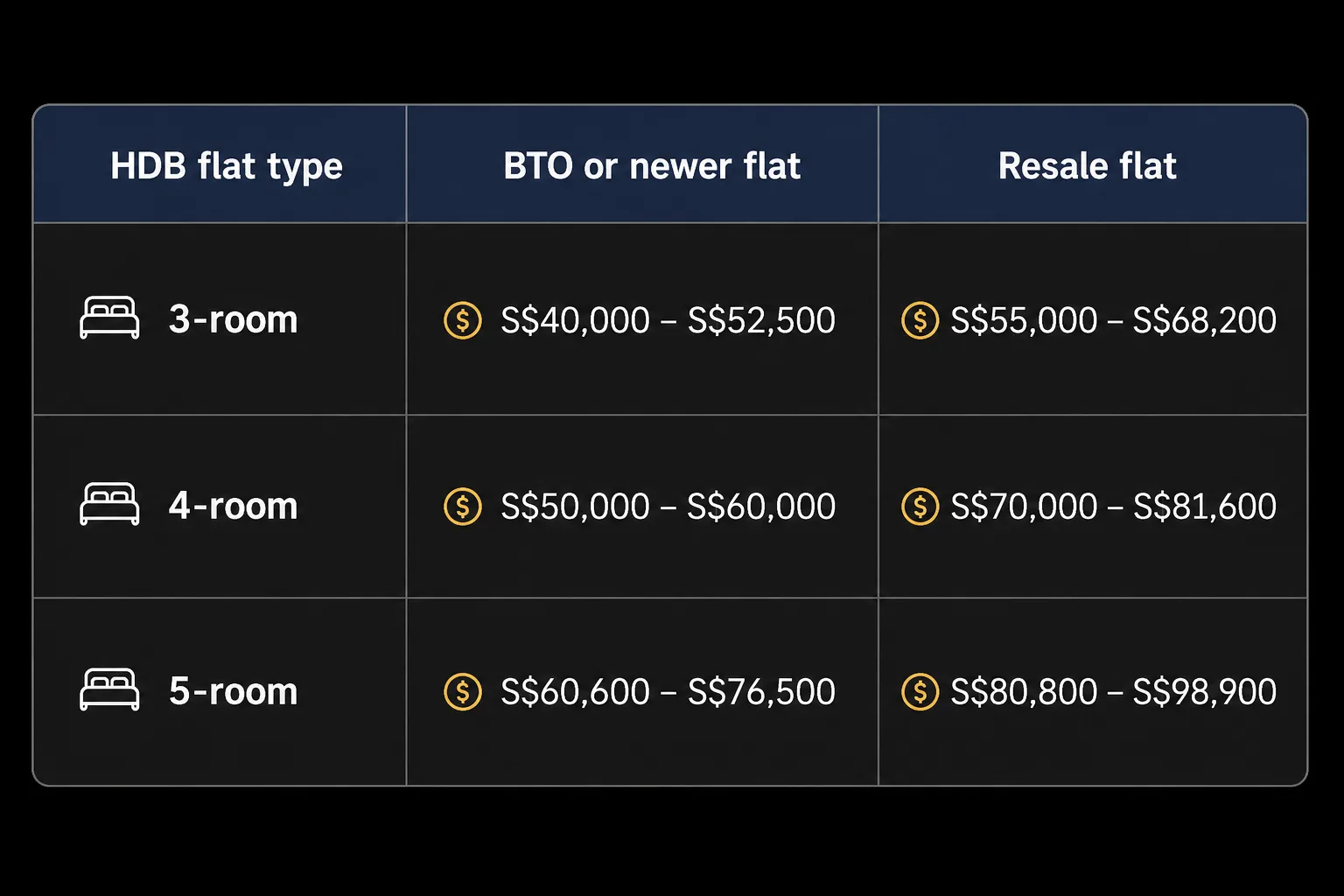
These figures should be treated as planning references rather than fixed market prices.
Your actual renovation cost may be lower if you retain most existing finishes, minimise built-in carpentry and avoid major layout changes.
It may be considerably higher if the project involves:
- Extensive hacking
- Full rewiring
- Plumbing replacement
- Custom carpentry throughout the home
- Premium tiles and fittings
- Major layout changes
- Replacement of windows and doors
- Structural or compliance-related work
- Delays and variation orders
Published 2026 benchmarks indicate that resale renovations generally cost more because they usually involve more labour-intensive removal, repair and replacement works.
Why Is Resale HDB Renovation Usually More Expensive?
A new BTO flat is generally delivered with a cleaner starting condition.
Depending on the project and optional component scheme selected, some BTO owners may already have flooring, internal doors or sanitary fittings installed.
A resale flat comes with an existing renovation that may have to be removed or modified.
This can add costs for:
- Hacking existing tiles and flooring
- Dismantling old carpentry
- Debris disposal
- Rewiring ageing electrical systems
- Replacing old water pipes
- Repairing uneven floors and walls
- Replacing damaged doors and windows
- Rectifying water seepage or moisture issues
- Repairing ceilings after removing old fixtures
- Upgrading the distribution board
- Making good concealed damage found during demolition
The condition of a resale flat may also be difficult to assess before demolition.
Once built-in cabinets, floor finishes or false ceilings are removed, additional defects may become visible. These discoveries can lead to variation orders and unplanned expenses.
BTO owners usually allocate more of their budget to carpentry, storage, lighting, feature finishes and visual upgrades.
Resale owners generally need to reserve a larger portion of their budget for demolition, electrical works, plumbing, tiling, repairs and contingency.
Estimated Renovation Budgets by HDB Flat Type
The following table combines published benchmarks for common flat types with indicative planning estimates for smaller flats and maisonettes.
Rows marked as indicative estimates are not official market medians.
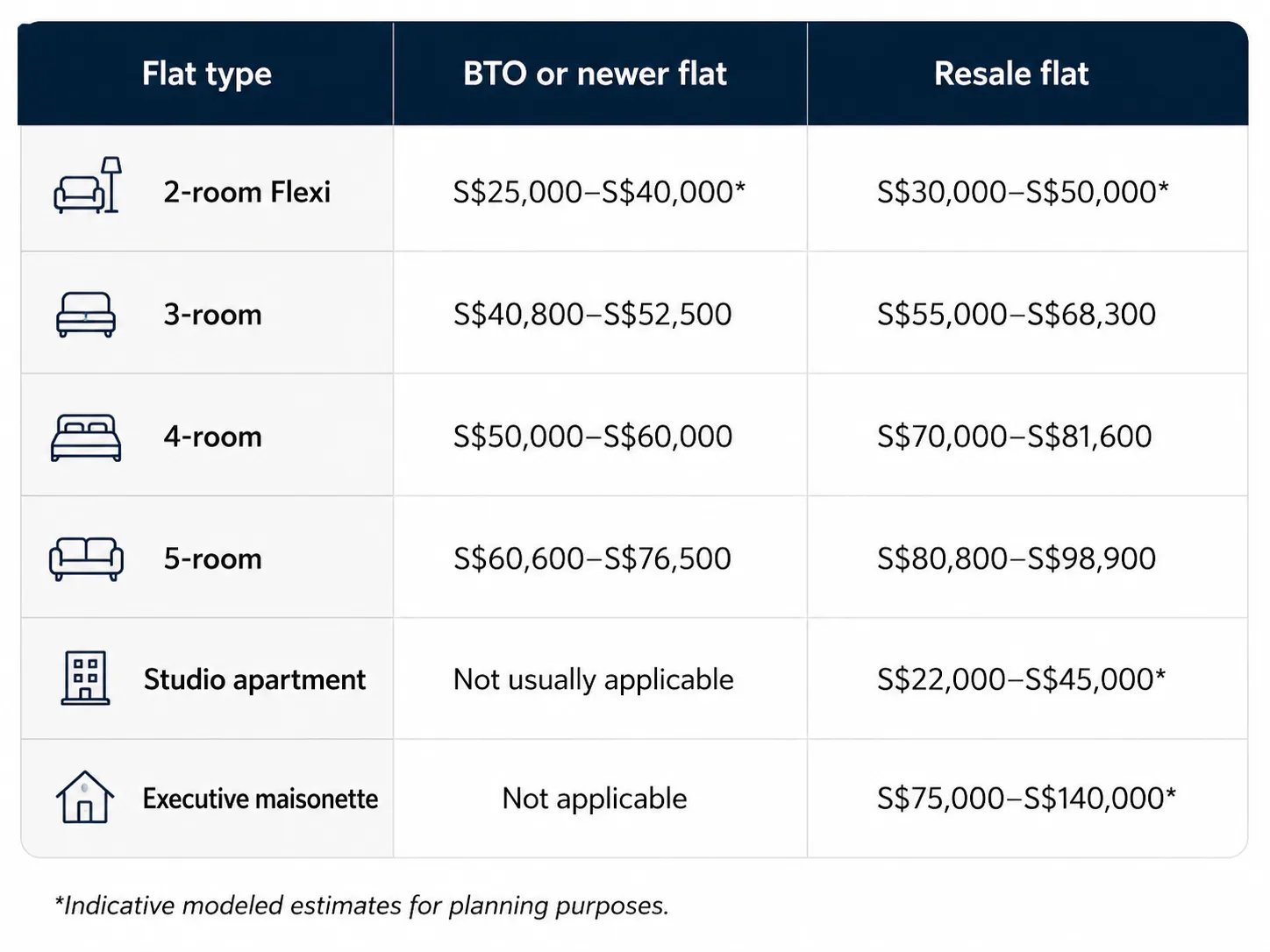
A 2-room Flexi flat may have a lower overall renovation bill, but it does not necessarily have a low cost per square metre.
Every complete home still requires essential areas and systems such as:
- A kitchen
- At least one bathroom
- Electrical points
- Lighting
- Plumbing
- Painting
- Storage
- Air-conditioning or ventilation
These create a baseline renovation cost regardless of whether the flat is 45 square metres or 90 square metres.
An executive maisonette carries the opposite challenge. Its larger floor area, staircase, additional walls and older existing condition can increase demolition, painting, flooring, electrical and carpentry costs significantly.
Typical HDB Flat Sizes and Their Effect on Renovation Costs
HDB resale flat sizes can vary considerably depending on the age, layout and development.
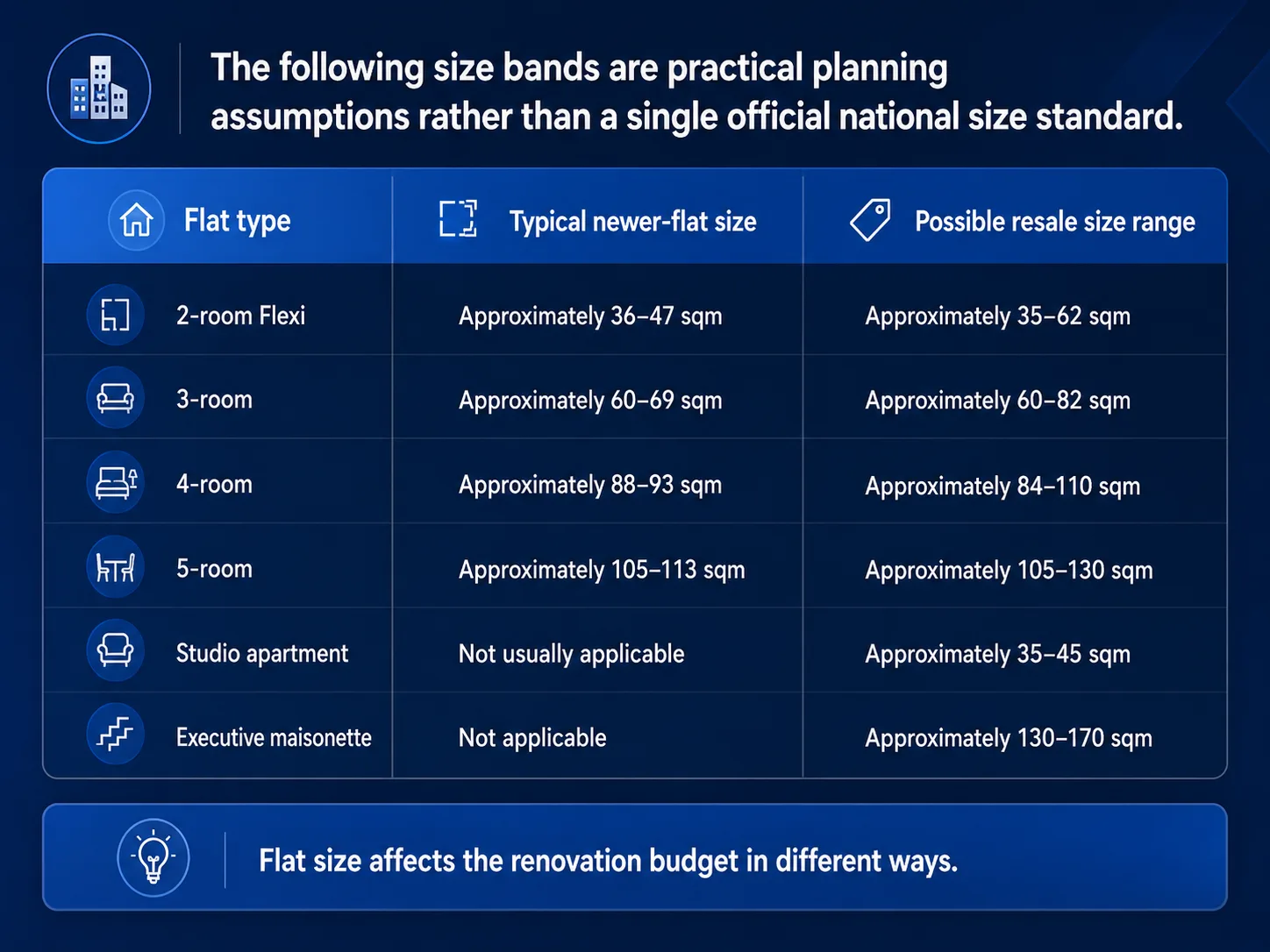
Larger flats increase total material and labour quantities
A larger home usually means:
- More flooring
- More wall and ceiling area
- Longer electrical runs
- More lighting points
- Additional carpentry
- More painting
- More air-conditioning capacity
- More doors and fittings
Smaller flats can cost more per square metre
A compact flat still requires a kitchen, bathroom, electrical system, plumbing and storage.
These fixed components form a larger percentage of the total renovation cost in a smaller home.
This is why renovation budgeting should not be based only on a simple cost-per-square-foot or cost-per-square-metre calculation.
Typical Renovation Cost by Trade
The following ranges can be used as broad 2026 planning estimates.
They are not official tariffs. Actual quotations will depend on measurements, specifications, materials and site condition.
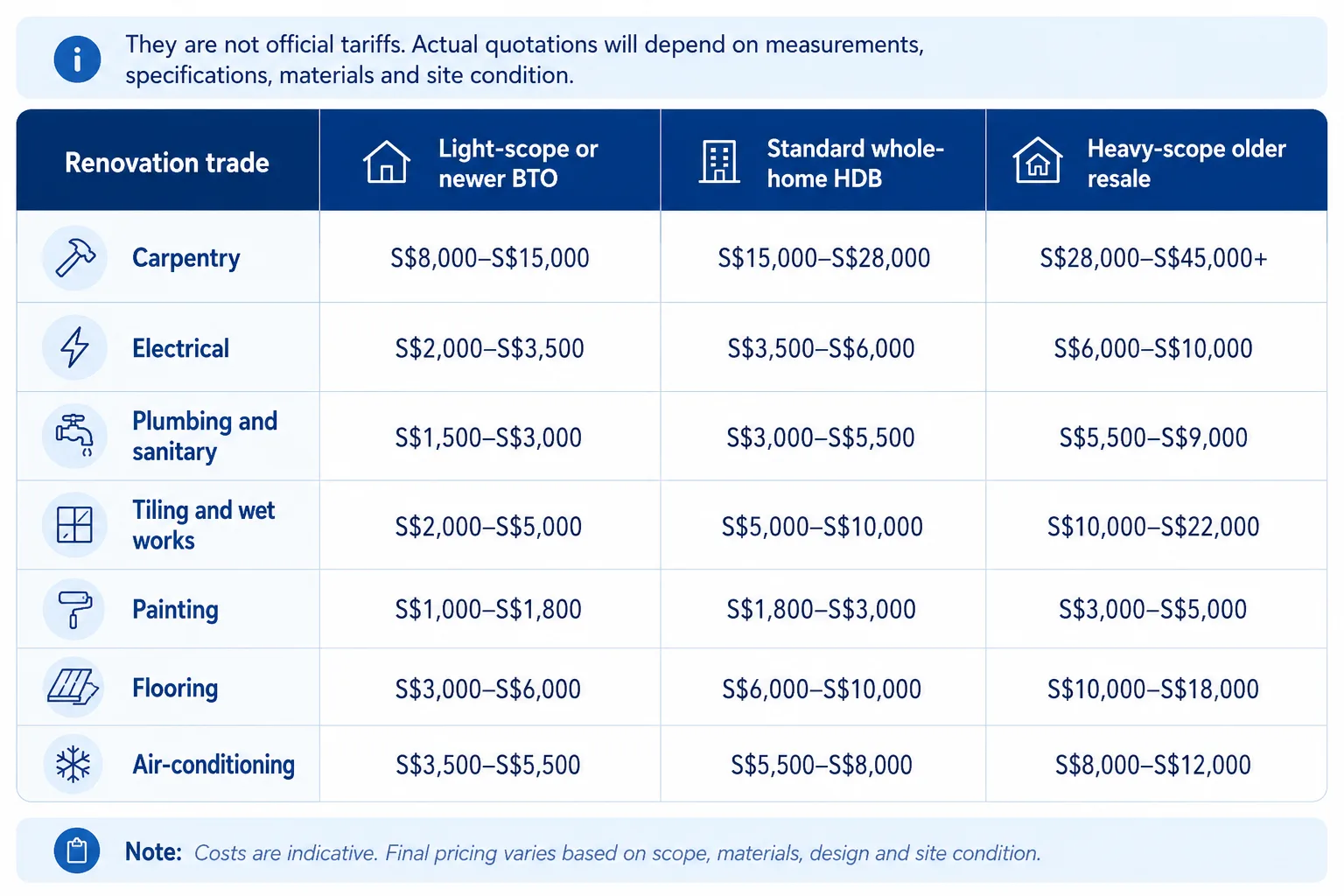
These categories do not always cover the entire renovation.
Homeowners may also need to budget for:
- Demolition and disposal
- Glass works
- Aluminium works
- Doors and gates
- Appliances
- Lighting fixtures
- Curtains and blinds
- Bathroom accessories
- Loose furniture
- Smart-home devices
- Cleaning
- Moving
- Storage
- Design or project-management fees
Carpentry is commonly one of the largest renovation expenses because built-in storage, kitchen cabinets, wardrobes and feature units require materials, fabrication and installation.
For resale flats, a larger portion of the budget may shift towards hacking, wet works, rewiring, plumbing and repairs.
How to Allocate a BTO Renovation Budget
A newer BTO flat usually requires less demolition and repair work.
A practical BTO budget may be allocated approximately as follows:
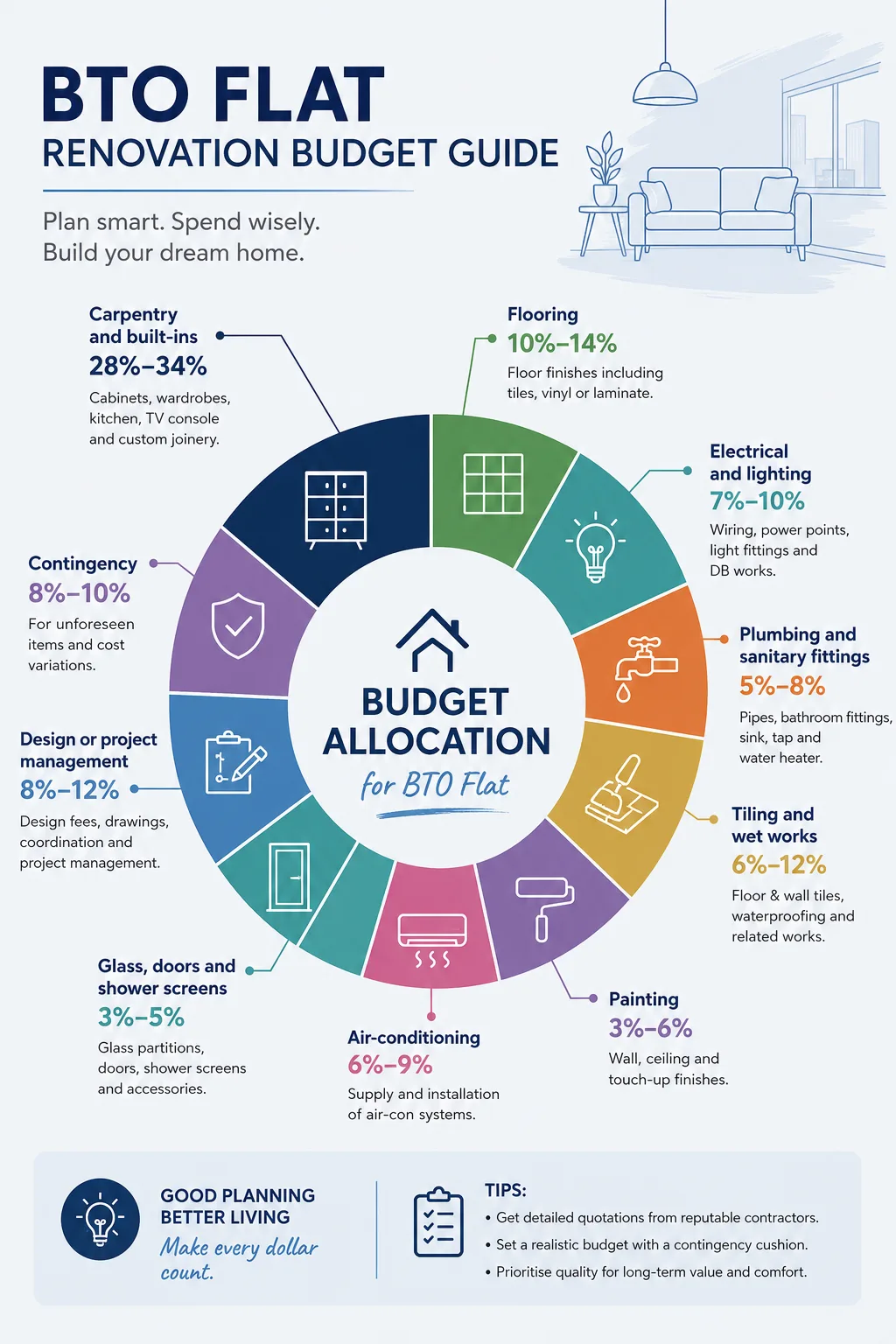
For a S$60,000 BTO renovation budget, this could mean allocating approximately:
- S$17,000–S$20,000 for carpentry
- S$6,000–S$8,000 for flooring
- S$4,000–S$6,000 for electrical and lighting
- S$4,800–S$6,000 as contingency
The percentages are not intended to be exact.
They help homeowners recognise when too much of the budget is being committed to one category while essential work remains unaccounted for.
How to Allocate a Resale HDB Renovation Budget
A resale renovation should reserve more money for existing-condition risks.
A practical allocation may look like this:
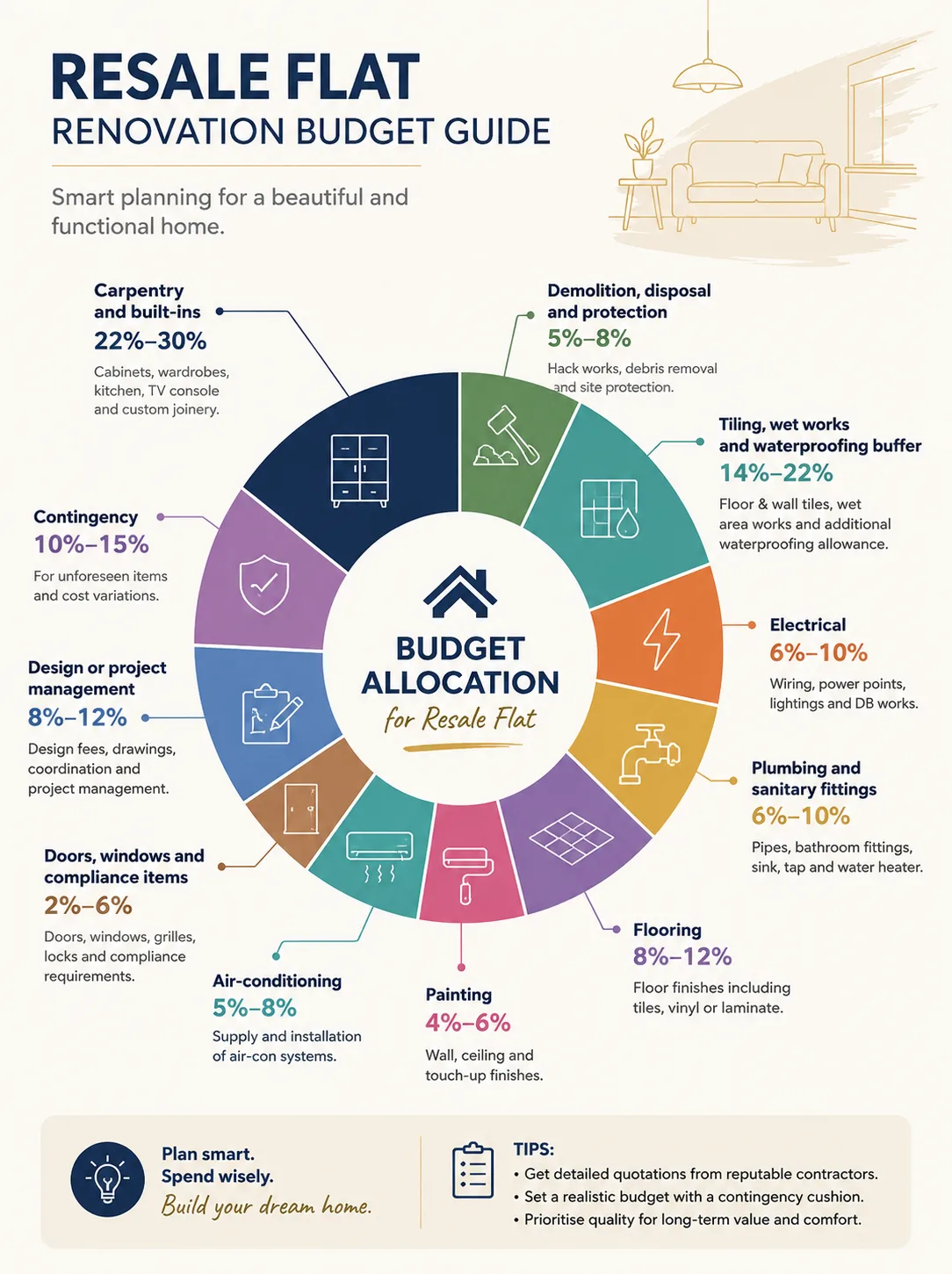
For a S$80,000 resale renovation, a 15% contingency represents S$12,000.
That may seem high before work begins, but it can be useful when demolition reveals:
- Corroded pipes
- Uneven floor screed
- Damaged wiring
- Moisture problems
- Hollow tiles
- Cracked walls
- Concealed water damage
- Non-compliant previous works
An unused contingency remains your money. An insufficient contingency may force you to borrow, delay essential work or compromise on important rectification.
HDB Renovation Rules That Can Affect Your Budget
Before confirming your renovation scope, homeowners should understand the HDB requirements that may affect cost and scheduling.
Use an HDB-registered renovation contractor
Renovation contractors carrying out HDB renovation works should be listed in HDB’s Directory of Renovation Contractors.
Registration does not automatically guarantee workmanship, pricing or service quality. Homeowners should still review the contractor’s experience, quotation and contract terms carefully.
Obtain permits before permit-required works begin
Certain renovation works require HDB approval.
These may include specific hacking works, replacement of certain doors or windows and other regulated alterations.
Do not assume that every proposed design can be approved simply because it appears in a drawing or quotation.
Renovation completion periods
Once renovation approval has been granted, HDB’s current framework expects renovation to be completed within:
- Three months for a new flat
- One month for an existing flat
This makes early planning, material confirmation and contractor coordination especially important.
Three-year BTO toilet restriction
Newly completed HDB flats generally have a three-year restriction against removing the original toilet wall and floor finishes.
This is intended to protect the waterproofing system.
BTO homeowners who want a different toilet appearance may have to consider overlay options or delay full hacking until the restriction period has passed.
Permitted renovation hours
Noisy works such as demolition and removal of finishes are generally restricted to weekdays between 9am and 5pm.
General renovation works are generally permitted from Monday to Saturday between 9am and 6pm.
These restrictions affect how quickly contractors can complete hacking-heavy works.
Household shelter restrictions
Household shelter walls should not be hacked or drilled in ways that affect their structural or protective integrity.
Any design involving the household shelter should therefore be reviewed carefully before carpentry or wall works are confirmed.
These requirements can change how a project is designed, priced and sequenced. Homeowners should verify the latest HDB requirements before beginning work.
Hidden Renovation Costs Homeowners Often Miss
The largest budget overruns are not always caused by expensive materials.
They often arise because an important item was excluded, assumed or poorly described in the quotation.
Hacking and disposal
Some quotations include hacking but exclude:
- Debris bags
- Haulage
- Disposal charges
- Lift protection
- Corridor protection
- Town Council-related charges
- Additional hacking discovered after work starts
Ask for hacking, protection, haulage and disposal to be listed separately.
Floor levelling and screeding
Overlay quotations may assume that the existing floor is sufficiently even.
If the surface is unsuitable, additional levelling, screed or hacking may be required.
Confirm whether the quotation assumes:
- Overlay
- Partial hacking
- Full hacking
- New screed
- Floor levelling
- Waterproofing work
Rewiring and distribution board upgrades
Older resale flats may require more electrical work than initially expected.
Before accepting the quotation, ask whether it includes:
- Full or partial rewiring
- Distribution board replacement
- Additional circuits
- Appliance isolators
- Concealed or exposed wiring
- Testing and certification
- Making good after rewiring
Variation orders
Variation orders are additional or omitted works agreed after the original contract.
They may arise from genuine changes, but they can also result from an incomplete quotation.
All variations should be:
- Described clearly
- Priced before work proceeds
- Approved in writing
- Added to the updated contract sum
- Reflected in the payment schedule
Premature payments
Avoid paying too much before the corresponding work has been completed.
A safer payment structure should follow clear milestones such as:
- Contract confirmation
- Completion of hacking and wet works
- Carpentry fabrication
- Carpentry installation
- Completion of major works
- Defect rectification
- Final handover
CaseTrust’s renovation framework includes safeguards such as progressive payments, transparent price breakdowns, written variation approvals and a workmanship warranty for accredited firms.
Smart Budgeting Tips for HDB Homeowners
1. Separate renovation from furnishing
Do not treat the renovation quotation as the complete cost of moving in.
Create separate budgets for:
- Renovation works
- Appliances
- Loose furniture
- Curtains and blinds
- Lighting
- Smart-home products
- Moving
- Temporary accommodation
- Storage
- Cleaning
A S$60,000 renovation can easily become an S$80,000 overall move-in cost after appliances and furniture are added.
2. Decide your non-negotiables
Identify what must be completed before move-in.
Examples may include:
- Safe electrical works
- Functional plumbing
- Essential kitchen carpentry
- Flooring
- Painting
- Air-conditioning
- Required storage
Decorative features can be reduced or completed later.
3. Compare scope, not only total price
A S$55,000 quotation is not necessarily cheaper than a S$60,000 quotation.
The lower quotation may exclude:
- Electrical points
- Disposal
- Plumbing fixtures
- Painting preparation
- Door replacement
- Floor levelling
- Hardware upgrades
- Delivery
- Protection works
- Cleaning
Place quotations side by side and compare identical scope items.
4. Ask for dimensions and quantities
Avoid descriptions such as:
- “Kitchen cabinet”
- “Feature wall”
- “Electrical works”
- “Toilet renovation”
Ask for measurable details such as:
- Carpentry length
- Cabinet height
- Number of drawers
- Laminate range
- Hardware brand
- Number of electrical points
- Tile size and quantity
- Painting area
- Number of coats
Detailed quotations reduce the space for later disagreement.
5. Keep a contingency fund
A sensible planning allowance is approximately:
- 8% to 10% for BTO renovations
- 10% to 15% for resale renovations
Use the higher end for older flats, hacking-heavy work and homes where the condition of wiring, plumbing or wet areas is unclear.
6. Avoid excessive built-in carpentry
Built-in furniture can improve storage, but it is often one of the most expensive renovation categories.
Before approving a built-in unit, ask:
- Does it need to be permanently fixed?
- Can loose furniture perform the same function?
- Will my lifestyle change?
- Can the item be replaced easily?
- Is the storage truly necessary?
Prioritise carpentry in areas where custom sizing provides a clear benefit, such as the kitchen or awkward wall recesses.
7. Confirm all major purchases early
Late material selection can delay the renovation.
Confirm important items such as:
- Tiles
- Sanitary fittings
- Kitchen appliances
- Air-conditioning system
- Lighting
- Doors
- Flooring
- Carpentry laminates
- Countertop material
The contractor should know the exact appliance and fitting dimensions before final carpentry fabrication.
Frequently Asked Questions
How much does it cost to renovate a 4-room HDB flat in 2026?
A published 2026 benchmark places a 4-room BTO renovation at approximately S$50,000 to S$60,000 and a 4-room resale renovation at approximately S$70,000 to S$81,600.
The actual amount depends on the existing condition, scope, materials and level of carpentry.
Why is a resale renovation more expensive than a BTO renovation?
Resale renovations are more likely to involve hacking, disposal, rewiring, plumbing replacement, repairs, wet works and replacement of existing finishes.
BTO projects usually begin from a newer and cleaner condition.
Can I hack the toilet tiles in a new BTO flat?
Newly completed HDB flats generally have a three-year restriction against removing the original toilet wall and floor finishes.
Homeowners may need to consider overlay options or wait until the restriction period has passed.
How much contingency should I set aside?
A practical planning range is approximately 8% to 10% for BTO renovations and 10% to 15% for resale renovations.
Older resale flats and projects involving heavy hacking should generally use the higher end.
Which renovation category usually costs the most?
Carpentry is often one of the largest categories, particularly when the renovation includes full kitchen cabinets, wardrobes, feature units and extensive built-in storage.
For older resale flats, wet works, electrical works and demolition may also form a significant part of the budget.
Do I need an HDB renovation permit?
Some renovation works require HDB approval before they can begin.
Homeowners should confirm the requirements with their HDB-registered renovation contractor and check the latest HDB renovation guidelines before starting work.
Final Thoughts
There is no single correct HDB renovation budget for every homeowner.
A new 4-room BTO with a simple design may cost less than the published benchmark.
An older 3-room resale flat requiring full replacement works may cost more than a larger but newer home.
The strongest renovation budget is one that accounts for:
- Flat size
- Existing condition
- Required renovation scope
- HDB regulations
- Contractor inclusions and exclusions
- Material selections
- Project-management needs
- A realistic contingency fund
Do not choose a contractor based only on the lowest total quotation.
Review what is included, what is excluded, what may become a variation and who will be responsible for coordinating the work.
Already have a renovation quotation but are unsure whether the scope and pricing are complete? RenoMate can help homeowners review quotations, coordinate direct contractors, track progress and manage the renovation from engagement to handover. Contact us now
Disclaimer: This article is independently prepared by RenoMate based on personal experience, industry observations and publicly available research. It is not produced, approved, endorsed or supported by the Housing & Development Board (HDB). All renovation costs, flat sizes, timelines and budget allocations are indicative estimates only and may vary according to the flat’s condition, project scope, materials and contractor pricing. Homeowners should verify the latest renovation rules, permit requirements and guidelines directly with HDB and their appointed HDB-registered renovation contractor before commencing any work.