
RenoMate field notes
Condo Renovation Rules: MCST Approval Is Only One Step
A condo renovation can look straightforward until the first delivery. The furniture is ready, the owner has paid a renovation deposit, and the contractor says management has been informed. Then the truck arrives at the wrong entrance, the lift is unavailable, or the submitted drawing does not include the work about to begin.
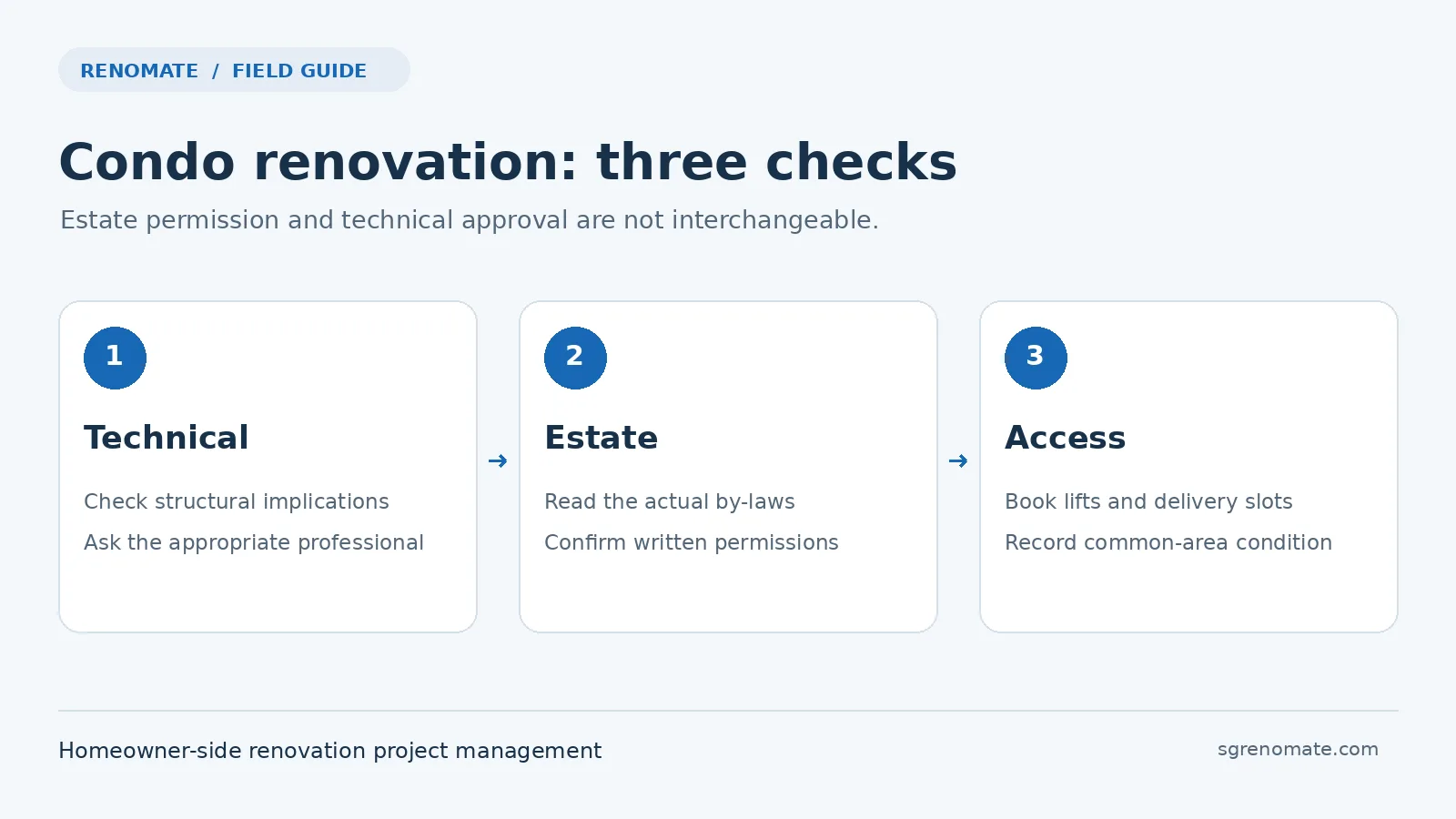
None of those problems is solved by choosing a nicer material or a more detailed quotation. They arise because technical permission, estate permission and practical access have been treated as one conversation. For a homeowner, separating them early is one of the most useful pieces of renovation planning.
Three checks, not one approval
Establish what the work requires technically, what your estate requires administratively and how each contractor will actually gain access. Paying a deposit or receiving a gate pass does not, by itself, settle the other questions.
What the MCST and managing agent do in this process
The Management Corporation Strata Title, usually shortened to MCST, manages the strata development; its managing agent often handles day-to-day applications and site arrangements. BCA's condo-owner guidance, updated in January 2026, advises owners to check with the MCST or developer before renovation and to observe the applicable by-laws. It also distinguishes works affecting structural elements or external appearance from ordinary internal changes.
Start by asking for the latest renovation application pack and the rules relevant to your scope. A contractor's experience in another condominium is helpful, but it is not a substitute for the current requirements in yours. Ask who can confirm approval and whether any response is conditional on further documents.
| Check | What to establish | What to keep |
|---|---|---|
| Technical and regulatory | Does the proposed work need professional assessment, submissions or statutory permission? | The professional's advice and applicable approved documents. |
| Estate requirements | What do the current by-laws and renovation conditions require for this scope? | The application, written response and attached conditions. |
| Access and logistics | When and how can people, materials and waste move through the estate? | Confirmed bookings, route instructions and site contacts. |
“No BCA submission needed” does not mean “no checks needed”
BCA identifies minor building works that may not require its plan approval. An exemption from one approval process does not remove other applicable requirements. Where structural work is involved, the appropriate professional must establish what assessment and approvals are needed; BCA also has a separate permit process for structural works.
The practical question is specific: what exactly is being altered, and who has assessed it? Do not classify a wall as safe to remove from a sales floor plan or because it sounds hollow. Ask the contractor to identify the element and obtain the appropriate advice before committing to a layout that depends on its removal.
Similarly, a proposed window, balcony treatment or external fixture should not be treated as an unrestricted interior-design decision. BCA's condo guidance explains that external appearance and relevant approvals can matter. Resolve those conditions before ordering a made-to-measure product that may be difficult to return.
Get the estate-specific answers that generic guides cannot give you
A useful condo renovation checklist should leave space for the actual estate's answers. Do not copy another development's permitted hours, deposit amount or Saturday policy into your schedule. Ask about the activities allowed at different times, whether particular work needs separate permission and how changes to the scope should be submitted.
Also ask about lift protection, loading and unloading, contractor registration, debris removal and any pre-work inspection. These are questions to verify, not assumptions that every estate imposes the same conditions. The aim is to give each trade a short, accurate briefing rather than a large PDF nobody has read.
A useful question for the managing agent
“Please confirm which documents or permissions are still outstanding for the attached scope, who issues the final confirmation, and whether any work or delivery can take place before that confirmation.” This is clearer than asking only whether the renovation form has been received.
Treat the renovation deposit separately from the contractor's bill
Ask who holds the estate deposit, what it covers, which deductions may apply and what has to happen before it is returned. Keep any administrative fee separate from money described as refundable. Neither should disappear into an unexplained lump sum in your renovation budget.
Before materials arrive, propose a dated condition record of the agreed common-area route: lift, door frames and corridor surfaces where relevant. Ask whether management has its own inspection process. The point is not to photograph the entire estate; it is to agree the starting condition of the areas your contractors will use.
At completion, request the close-out inspection or documents required under the agreed process. If a deduction is proposed, ask for the reason and supporting evidence. The paperwork is much easier to discuss when the starting condition and responsibility for protection were recorded before work began.
Book the route, not only the delivery date
For bulky items, confirm the packed dimensions as well as the finished product size. Ask the delivery team whether the item can use the intended loading area, lift and corridor route. A dining table that fits the room may still be difficult to bring through a tight turn in its protective crate.
Coordinate deliveries against site readiness. Bringing a sofa into a flat while dusty work continues may create a storage and protection problem rather than save time. If the main contractor changes the work sequence, someone must tell the supplier before the truck is dispatched.
This is particularly relevant when you source separate trades and products. Our comparison of interior designers and direct contractors explains the broader choice. In a condo, whichever model you choose still needs a named person handling estate access and changes to the plan.
When someone says management will not allow it
Ask what exactly has been declined and why. Is it the work itself, an incomplete application, the requested time slot or the proposed delivery route? Those are different problems and may need different responses. Request the relevant condition in writing, then review the proposal rather than escalating a vague disagreement.
BCA's guidance describes routes for resolving strata disagreements, but the right route depends on the issue. Start with a clear written account and a practical discussion with management. For a contested legal right or significant financial dispute, obtain appropriate advice rather than relying on a contractor's interpretation.
RenoMate's role is to coordinate the homeowner's renovation, including contractors, deliveries and agreed site arrangements. We can help keep the questions and decisions organised; we cannot grant MCST permission, certify structural safety or override an estate's valid requirements. A clear boundary makes the service more useful, not less.
Common questions
Does MCST approval replace BCA approval?
No. Estate permission does not replace any statutory approval required for the works. Conversely, an exemption from BCA plan approval does not automatically remove estate or other requirements.
Are condo renovation hours and deposits the same everywhere?
Do not assume they are. Obtain your estate's current by-laws, renovation conditions and application requirements. Confirm the permitted activities, working hours, deposit deductions and return process in writing.
Can I change a window or balcony enclosure because it is inside my unit?
Do not decide this from location alone. External appearance, common-property and regulatory requirements may apply. Ask the MCST or developer and the appropriate professional about the exact proposal before ordering or installing it.
What should I do if the renovation deposit is not returned?
Ask for the written reason, the relevant condition and evidence of any claimed damage or charge. Compare it with the pre-work condition record and agreed return process. Seek appropriate advice if the dispute cannot be resolved; do not assume every deduction is valid or invalid.
Want one clear plan for the contractors and the estate?
Share the proposed works and your management office's requirements with RenoMate. We can discuss the coordination needed before you commit to the start date.
Guidance checked on 6 October 2026. Requirements depend on the work, the development and applicable law. This article is not a structural assessment or legal opinion; obtain advice from the relevant professional and current written requirements from your estate.