
RenoMate field notes
Interior Designer vs Direct Contractor for Singapore BTO: Which Should You Choose?

When planning a home renovation in Singapore, most homeowners begin with one major decision:
Should you engage an interior designer or work directly with contractors?
An interior designer can provide design guidance and manage most of the renovation on your behalf. Direct contractors may offer better cost visibility and greater control, but you will usually need to coordinate the project yourself.
Neither option is automatically better. The right choice depends on your design needs, available time, renovation knowledge and preferred level of involvement.
This guide explains the key differences between engaging an interior designer and managing direct contractors, as well as a third option for homeowners who want more control without managing the entire renovation alone.
What Does an Interior Designer Do?
An interior designer, commonly referred to as an ID, usually provides both design and renovation coordination.
Depending on the company and package, an ID may assist with:
- Space planning
- Design concepts and mood boards
- Material and colour selection
- 3D visualisations
- Renovation quotations
- Contractor coordination
- Site inspections
- Progress updates
- Defect rectification
- Final handover
The homeowner generally communicates with one main designer or project coordinator, while the ID firm manages its own contractors and subcontractors.
Advantages of Engaging an Interior Designer
1. You receive design guidance
An ID can help turn your ideas into a complete and consistent design.
This is useful for homeowners who know how they want their home to feel but are unsure about space planning, materials, colours or detailing.
2. You have one main point of contact
Instead of communicating separately with the carpenter, electrician, plumber, painter and tiler, you usually communicate through the ID.
This can reduce the amount of daily coordination required from the homeowner.
3. The renovation sequence is generally managed for you
Renovation works must happen in the correct order.
For example, electrical points may need to be confirmed before carpentry fabrication begins. Flooring may need to be completed before certain fittings and furniture can be installed.
An ID is generally responsible for coordinating these activities and adjusting the schedule when delays occur.
4. It can be more convenient
For homeowners who work long hours or do not want to manage multiple contractors, an ID can provide a more hands-off renovation experience.
However, the actual level of support will depend on the company and the person assigned to manage your project.
Disadvantages of Engaging an Interior Designer
1. Individual contractor costs may be less visible
Most ID quotations are presented as a complete renovation package.
You may know the price of each work category, but you may not know how much the individual contractor is charging the ID firm.
This does not necessarily mean that the quotation is unreasonable. The overall price may include design work, project management, administrative costs, business overheads and profit.
However, homeowners seeking full cost transparency may prefer to appoint contractors directly.
2. You depend heavily on the assigned designer
A reputable company can still provide different experiences depending on the designer or project manager assigned to your renovation.
Some designers are highly organised and provide regular updates. Others may be managing several sites at once and may not always respond as quickly as expected.
3. Changes can increase the final renovation cost
Changes made after the quotation has been accepted may result in variation orders.
These can include:
- Additional electrical points
- Material upgrades
- Changes to carpentry dimensions
- Extra painting works
- Additional hacking or disposal
- Items that were excluded from the original quotation
Homeowners should ensure that the original scope is sufficiently detailed before work begins.
What Does Engaging Direct Contractors Mean?
Engaging direct contractors means appointing the companies or trades carrying out the work yourself.
For example, you may separately engage:
- A carpentry contractor
- An electrician
- A plumber
- A tiling contractor
- A painting contractor
- An air-conditioning company
- A glass contractor
- A flooring supplier
Instead of paying one ID firm to manage the entire renovation, you communicate and contract directly with each party.
This may offer more control and cost visibility, but it also means that someone must take responsibility for managing the overall project.
In most cases, that person is the homeowner.
Advantages of Engaging Direct Contractors
1. Greater cost visibility
Direct contractors usually quote specifically for their own portion of the work.
This allows you to compare prices, specifications and materials between different companies.
You can see how much is allocated to carpentry, electrical works, flooring, painting and other trades instead of receiving only one bundled quotation.
2. More control over contractor selection
You decide who carries out each portion of the renovation.
You may choose one contractor based on pricing, another based on workmanship and another because of a trusted recommendation.
You are not limited to the contractor network used by a particular ID firm.
3. Direct communication
You can speak directly with the contractor carrying out the work.
This may reduce the risk of instructions being misunderstood as they pass through several parties.
However, important instructions and changes should still be recorded in writing.
4. Potential cost savings
Engaging contractors directly may reduce some design, coordination and mark-up costs.
However, direct contracting is not automatically cheaper.
Any savings can be reduced by:
- Incorrect measurements
- Missing quotation items
- Poor scheduling
- Additional delivery charges
- Contractor downtime
- Rework
- Unplanned variation orders
- Damage caused by overlapping trades
The final cost depends on how well the renovation is planned and managed.
Disadvantages of Engaging Direct Contractors
1. You become the project manager
Removing the ID does not remove the need for project management.
Someone must still:
- Compare quotations
- Confirm the work scope
- Arrange the work sequence
- Coordinate site access
- Answer contractor questions
- Track progress
- Resolve clashes between trades
- Schedule deliveries
- Inspect completed work
- Follow up on defects
When contractors are engaged directly, these responsibilities generally fall on the homeowner.
2. Each contractor may only focus on their own work
A carpenter may not be responsible for ensuring that the electrical contractor has completed every required point.
A flooring contractor may not coordinate with your furniture delivery company.
Each contractor may complete their own scope correctly while the overall project still experiences delays or conflicts.
3. Scheduling becomes more complicated
One delayed trade can affect several others.
For example:
- Late tiling may delay carpentry installation.
- Delayed electrical work may hold up ceiling closure.
- Incorrect measurements may require carpentry to be remade.
- Early furniture delivery may obstruct unfinished renovation works.
The homeowner must understand these dependencies and adjust the schedule accordingly.
4. Responsibility for defects may be disputed
When several contractors are involved, it may not always be clear who caused a defect.
A damaged wall may be blamed on the carpenter, electrician or delivery team. A plumbing leak may affect carpentry, flooring and painting.
Without proper documentation, resolving responsibility can become difficult.
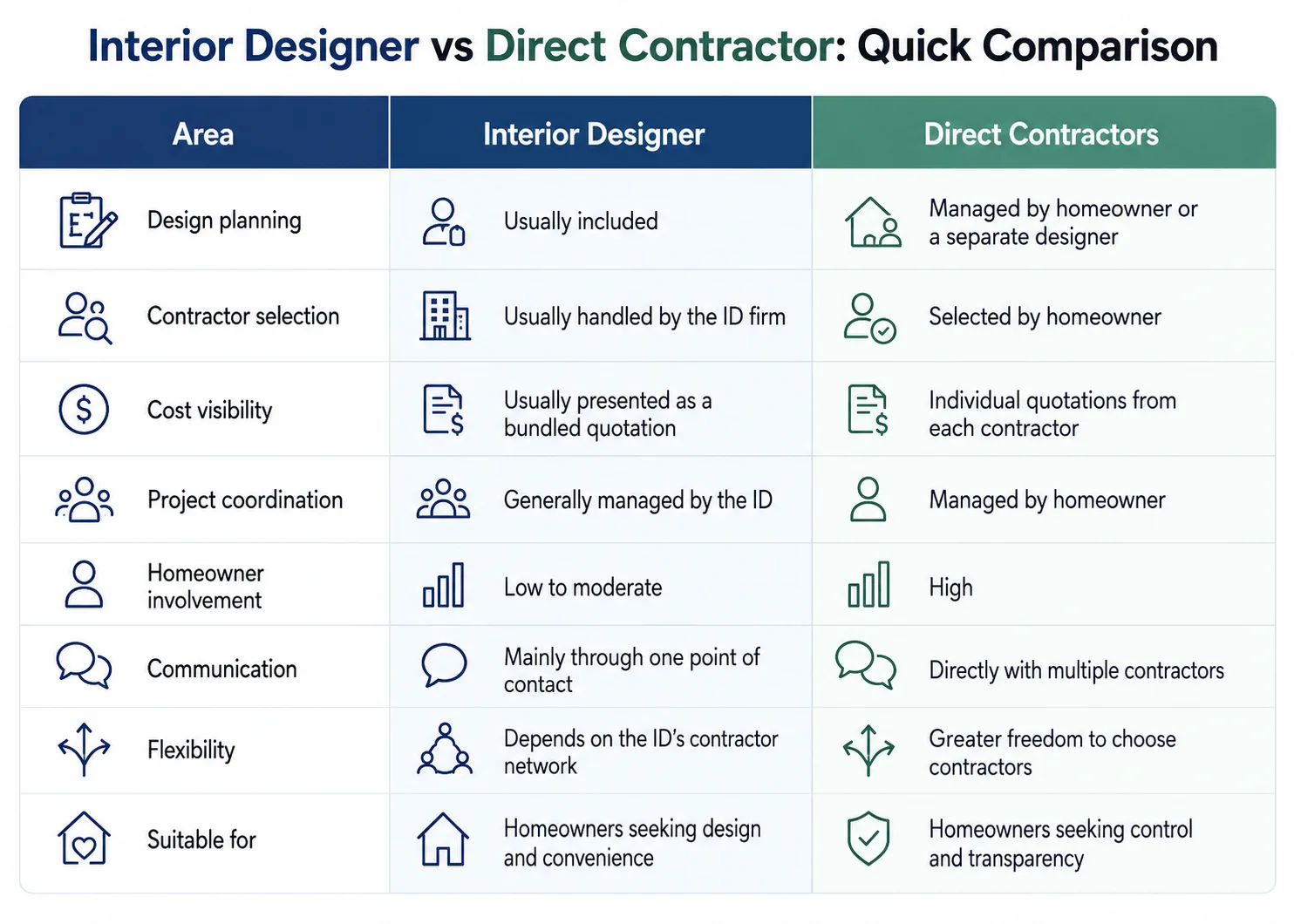
Interior Designer vs Direct Contractor: Quick Comparison
Which Option Is Cheaper?
Direct contractors may appear cheaper because design and project-management services are not included in the same way.
However, homeowners should compare more than the initial quotation.
Consider the potential cost of:
- Taking leave to attend site meetings
- Coordinating several contractors
- Correcting measurement errors
- Paying for repeated deliveries
- Managing delays
- Rectifying damage or poor workmanship
- Handling missing quotation items
- Resolving disagreements between contractors
An ID quotation may be higher because the price includes design, coordination and business overheads.
Direct contracting may provide better value when the homeowner already has a clear design, understands the renovation process and has sufficient time to manage the work.
The cheapest quotation is not always the option with the lowest final cost.
Who Should Engage an Interior Designer?
An interior designer may be more suitable when:
- You need help developing the overall design.
- You want professional space planning and visualisation.
- You prefer one main point of contact.
- You have limited time to manage contractors.
- You want one company to oversee most of the renovation.
- You are comfortable paying for design and coordination support.
Who Should Engage Direct Contractors?
Direct contractors may be more suitable when:
- You already have a confirmed design.
- You understand the required renovation sequence.
- You want to compare individual contractor quotations.
- You have time to visit the site and follow up regularly.
- You are comfortable managing several contractors.
- You can document instructions, changes and defects properly.
- You want direct control over contractor appointments and payments.
Is There a Middle Option?
Some homeowners want to appoint contractors directly but do not have the time or experience to manage every part of the renovation.
This is where a homeowner-side renovation project-management service may help.
RenoMate supports homeowners who wish to retain direct control over their contractors while receiving assistance with the coordination and management of the renovation.
Depending on the selected service scope, RenoMate can assist with:
- Reviewing renovation quotations
- Identifying unclear or missing scope items
- Coordinating appointed contractors
- Tracking the renovation schedule
- Following up on outstanding works
- Recording site progress and issues
- Coordinating furniture and online deliveries
- Inspecting completed work
- Tracking defect rectification
- Supporting the final handover
The homeowner continues to appoint and pay the contractors directly.
RenoMate does not replace the contractors performing the work. Its role is to help keep the project organised and provide homeowner-side support throughout the renovation.
Who May Benefit From RenoMate?
RenoMate may be suitable when:
- You want to engage direct contractors.
- You already have a design or renovation direction.
- You want greater cost visibility.
- You do not want to manage the renovation entirely alone.
- You work long hours and cannot visit the site regularly.
- You need help comparing contractor quotations.
- You want someone to follow up on progress and defects.
- You are ordering furniture or fittings from multiple suppliers.
It provides a middle ground between paying an ID firm to manage the complete renovation and taking on every project-management responsibility yourself.
Questions to Ask Before Choosing
Before deciding between an ID and direct contractors, ask yourself:
- Do I need help designing the home?
- Is my renovation scope already confirmed?
- How much time can I spend managing the project?
- Am I comfortable reviewing technical quotations?
- Can I coordinate several contractors at the same time?
- Do I understand the correct sequence of renovation works?
- Who will inspect the work and follow up on defects?
- Do I prefer one bundled quotation or separate contractor prices?
- How much control do I want over contractor selection?
- Who will manage the project when I am unavailable?
Your answers will help determine the most suitable renovation approach.
Final Thoughts
Choose an interior designer when you need design guidance and prefer one company to oversee most of the renovation.
Choose direct contractors when you already have a clear plan, want greater cost visibility and are prepared to manage the renovation yourself.
Consider RenoMate when you want to appoint contractors directly but need support managing quotations, timelines, coordination, progress, deliveries, defects and handover.
The right option is not simply the one with the lowest initial price.
It is the option that provides the right balance of design, control, transparency and project-management support for your renovation.
Planning to work with direct contractors but do not want to manage everything alone? Learn how RenoMate can support your renovation from engagement to handover.