
RenoMate field notes
BTO Defect Check: What to Settle Before Renovation Starts
You have collected the keys, your contractor is asking for a start date, and the new-flat chat group is sharing photos of chipped tiles and uneven doors. It is tempting to book a defect inspection, forward the report and consider that part settled. The harder question comes a week later: which repairs are actually finished, and can the renovation begin without covering something that still needs attention?
Earlier key collection can make that decision more pressing. In an April 2026 parliamentary answer, around 30 per cent of BTO blocks completed in 2025 were reported to have finished ahead of their booking-stage estimate, by about two months on average. Getting the flat sooner is welcome. It does not mean your inspection, contractor and delivery plans are already ready.
The useful outcome of a defect check
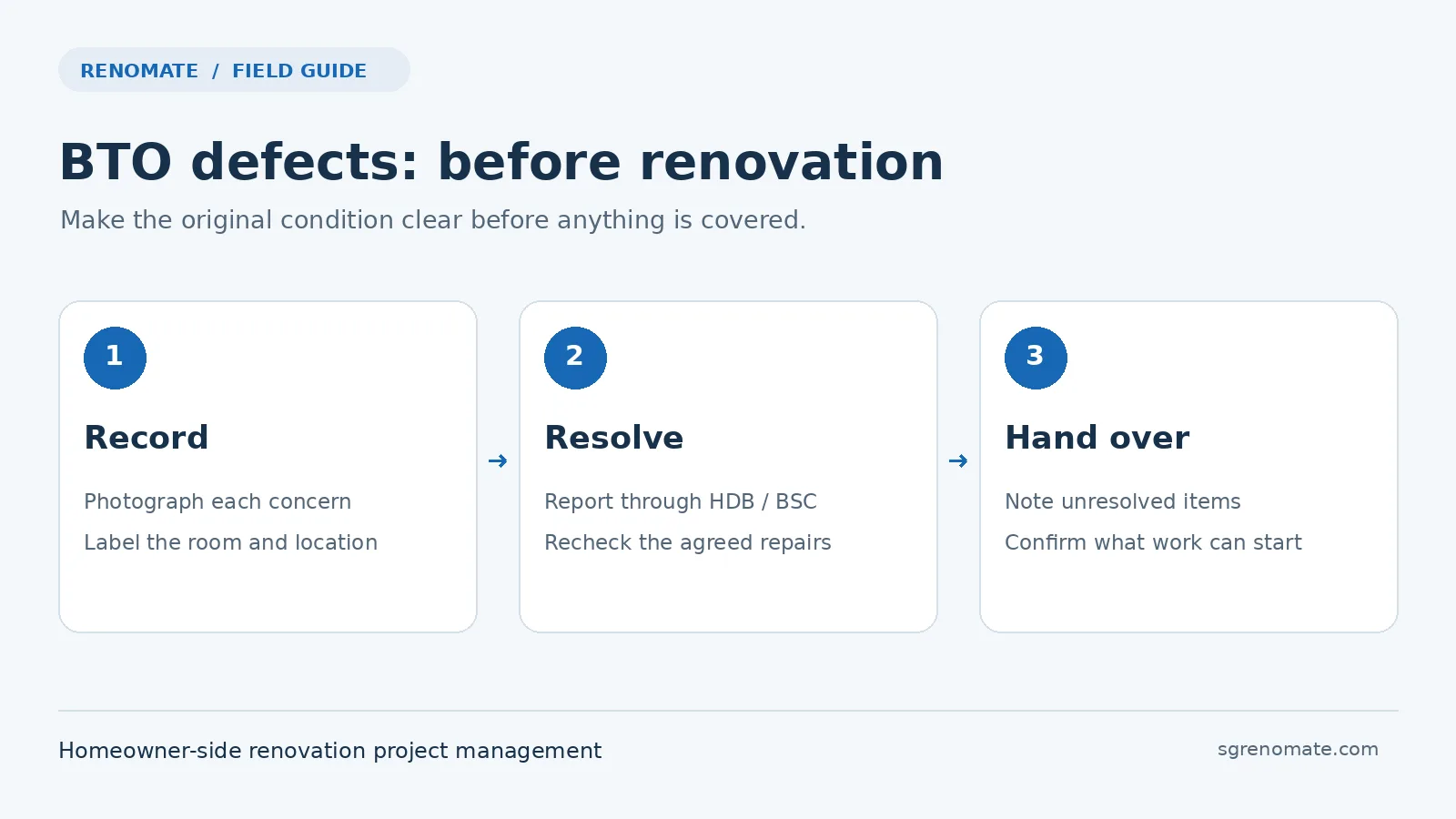
Aim for a clear record of the flat's original condition, a prioritised repair list and an agreed handover to your renovation contractor. A long list of stickers is not the same as a resolved list of issues.
Understand the reporting window without rushing the inspection
HDB's guidance on defects in new flats provides a one-year defects liability period from key collection. Homeowners are advised to report initial defects within a month and before renovation, through the reporting arrangements for their development, including the Building Service Centre, or BSC. The early-reporting advice and the one-year period serve different purposes; do not confuse them.
Our practical recommendation is to inspect while the original finishes are still visible. Once flooring protection, cabinetry or new paint covers a surface, showing what it looked like before becomes harder. That is an evidence problem as much as a scheduling problem. Keep the initial report, the submission acknowledgement and the repair correspondence together.
Prioritise the consequence, not the defect count
A report with 60 observations is not automatically more serious than one with six. A slight cosmetic inconsistency and a recurring wet patch call for different attention. CNA's explainer on BTO defects makes this distinction between minor imperfections and issues with more consequential causes. For renovation planning, add another question: will the next trade conceal the issue or make repair harder?
| Priority | Examples to flag | Planning response |
|---|---|---|
| Safety or active damage | An apparently loose fitting, a persistent leak or another immediate concern. | Stop using the affected item and seek assessment. Do not experiment with repairs. |
| Blocks the next trade | An unresolved wall or floor issue where cabinetry or a finish is due. | Keep that area accessible and agree the repair sequence first. |
| Function or finish | A sticking door, damaged finish or a cosmetic concern. | Record it clearly, agree the response and recheck before closing the item. |
This approach avoids two expensive extremes: rushing ahead over an unresolved problem, or stopping an entire renovation because nobody has separated an isolated touch-up from an issue that affects the next trade. Where safety or the cause of damage is uncertain, get the appropriate assessment rather than treating the table as a diagnosis.
Make the photos useful to someone who was not there
Take one wider photo showing the location and one close-up showing the concern. Use consistent labels such as Bedroom 2, window wall, lower left corner. Describe what you can observe rather than declaring a cause: “damp patch returned after rain” is more useful than an unsupported conclusion about failed waterproofing.
A simple record can contain the item number, room, observation, photo reference, date reported, agreed action and recheck result. Keep a short video for a movement or operating problem that a still image cannot show. Avoid destructive testing or improvised flooding; an inspection should not create a new problem.
Example of a useful record
Illustrative entry: B2-04 / Bedroom 2 door / catches on the frame when closing / photos B2-04A and B2-04B / reported 16 October / adjustment proposed / recheck pending. This is a sample format, not a RenoMate customer case.
Do not let “attended to” become “accepted” by default
Arrange a recheck after the reported repairs. Revisit the original concern and inspect the surrounding area for new marks or damage. Record whether the issue was resolved, partly addressed or still needs clarification. A contractor's attendance tells you someone visited; it does not tell you the result.
Discuss disputed items calmly and in writing. Ask what was assessed, what action was taken and what remains outside the proposed repair. This is more productive than repeatedly forwarding the same unlabelled photograph. Where another visit is needed, agree access before your own contractor starts storing tools or materials in the room.
Agree an area-by-area handover to the renovation team
Before work begins, walk through the flat with your renovation contractor. Share the unresolved list and identify areas that must stay accessible. Record the condition of finishes and fittings that will remain, including any existing marks. This helps distinguish original concerns from later renovation damage without relying on memory.
For example, unresolved work on a wall behind a planned wardrobe deserves attention before fabrication or installation fixes the design around that wall. An isolated touch-up elsewhere may be easier to coordinate separately. Whether work can proceed is a discussion for the BSC and the relevant contractors, not an automatic yes based on the number of outstanding items.
Keep the renovation start date conditional until those dependencies are understood. Our BTO renovation timeline guide explains the later trade sequence; the defect-to-renovation handover is the step that needs to happen before that sequence becomes reliable.
When outside help is worth paying for
A professional inspection can be useful when you lack time, are unsure how to describe a concern or want an organised second opinion. Ask what is inspected, what is excluded and whether the fee includes a reinspection. The deliverable should help you close issues, not just provide a dramatic number to share in a group chat.
Inspection and renovation management are different jobs. RenoMate's homeowner-side support focuses on coordinating the agreed renovation scope, site progress, decisions and handover. It does not replace HDB's defect process. Where support is appropriate, the useful link is carrying the unresolved issues into the renovation plan so they are not forgotten when the next contractor arrives.
Common questions
How long is the defects liability period for a new BTO flat?
HDB states that new flats have a one-year defects liability period from key collection. Its advice to report initial defects within a month and before renovation is an early-reporting recommendation, not a replacement for that one-year period. Check the official instructions for your flat.
Must every cosmetic defect be repaired before renovation starts?
Do not assume either that every small mark must halt the whole project or that all work can proceed. Agree with the Building Service Centre and your contractor which areas can be released without concealing defects or obstructing repairs, and record unresolved items.
Do I need to pay for a professional BTO defect inspection?
It is a choice, not a substitute for reporting defects through HDB. Consider the inspector's scope, the usefulness of the report and whether a reinspection is included. A paid inspection is most valuable when it helps you understand and close issues, rather than simply producing a large defect count.
Does starting renovation automatically remove all HDB defect cover?
Avoid that blanket assumption. Renovation can alter the original condition and complicate assessment of a later complaint. Report concerns early, preserve evidence and ask HDB about any unresolved issue before the affected area is altered.
Need help joining the inspection and renovation plans?
Share your renovation stage, outstanding issues and proposed start date with RenoMate. We can discuss what needs coordination and whether project-management support fits your situation.
Guidance checked on 6 October 2026. Follow the current HDB and BSC instructions for your development. The planning examples above are suggestions, not technical assessments or official defect classifications.